English
At Sikh Heritage Girls School, English is taught with ambition, precision and a genuine love of language. We want our girls to become confident readers, accomplished writers and articulate speakers who can understand complex ideas, express themselves clearly and recognise the power of language to inform, persuade, entertain and inspire.
Our curriculum is designed in-house. Strong foundations in phonics, spelling, handwriting, grammar and fluency are taught carefully, while pupils are also introduced to rich literature, increasingly sophisticated language and purposeful opportunities to write and speak.
We want girls who read beyond the surface of a text, make deliberate choices as writers and communicate their ideas with confidence and authority.
Intent
Our English curriculum develops pupils who read fluently and widely, write accurately and imaginatively, and speak with clarity and purpose.
We want pupils to understand increasingly complex vocabulary and ideas, make thoughtful choices about language and structure, and develop the stamina and independence needed for sustained reading and writing.
Strong communication is not simply about using impressive words. It is about choosing the right words, organising ideas carefully and understanding how language affects the reader or listener.
Implementation
English knowledge and skills are deliberately sequenced so that pupils build securely from one stage to the next. New learning is modelled explicitly, practised carefully and revisited until pupils can use it with increasing independence.
Reading, writing and spoken language are closely connected. Girls discuss what they read, notice how writers use language, rehearse ideas aloud and apply what they have learned within their own writing.
Pupils encounter writing worth studying and are taught to notice how accomplished authors construct sentences, create atmosphere, develop characters, organise ideas and influence their readers. As their confidence grows, responsibility gradually shifts from the teacher to the pupil so that girls can make increasingly independent choices.
Reading
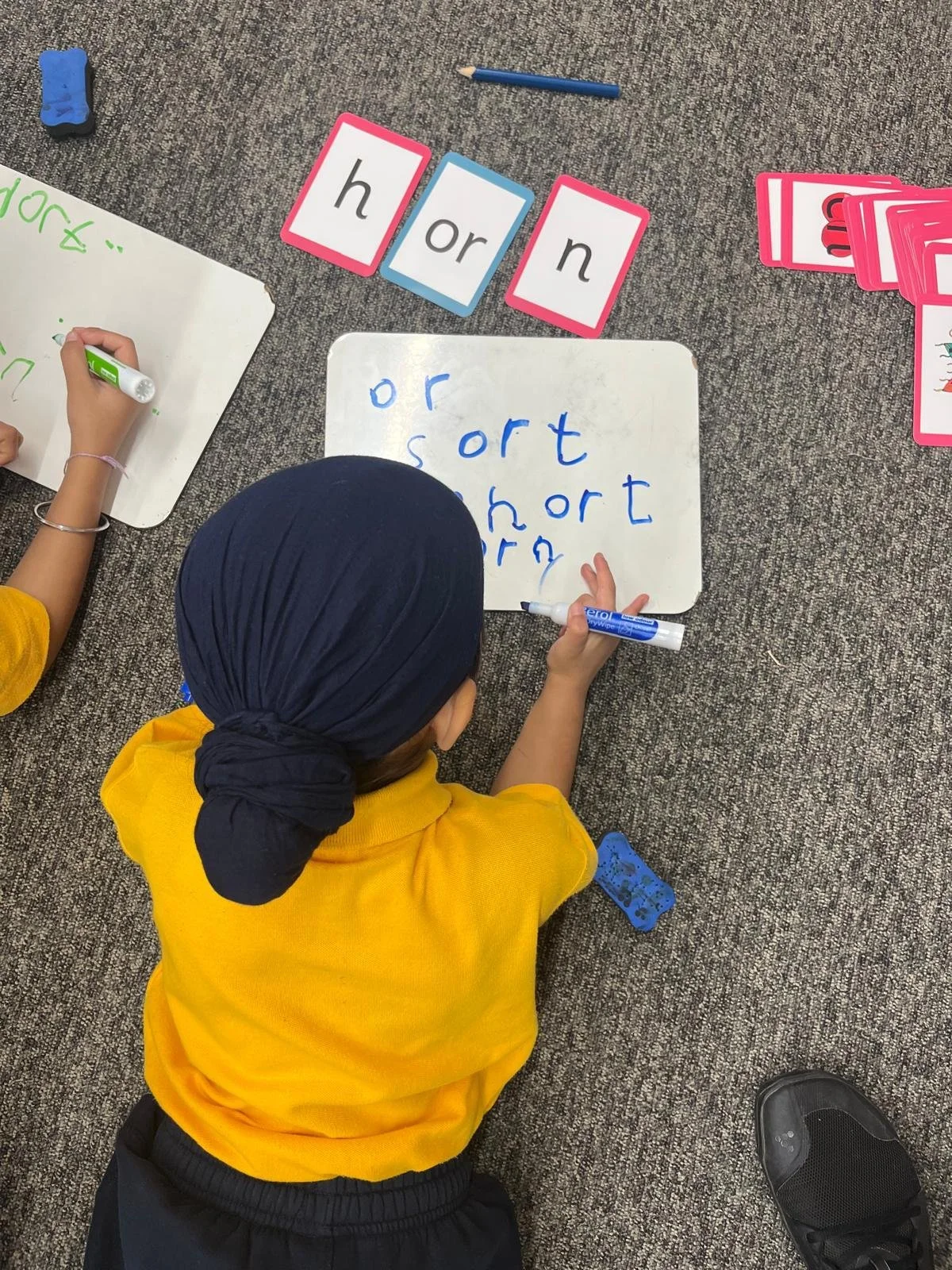
Our early reading curriculum uses Little Wandle Letters and Sounds Revised, supported by carefully matched Collins Big Cat books. Pupils are taught to decode accurately and develop the fluency and automaticity that allow increasing attention to be given to meaning.
As girls become more confident readers, they learn to read with expression, interpret vocabulary in context, infer meaning, identify themes and discuss the choices writers make.
Text selection is taken seriously at SHGS. Pupils encounter classic and contemporary fiction, poetry, plays, non-fiction and writing from different cultures and traditions, with texts becoming increasingly demanding as they progress through the school.
Reading for pleasure remains equally important. Our much-loved Choosey Tuesday gives girls the opportunity to bring in and share something they genuinely enjoy reading, whether that is a novel, comic, magazine, map, menu or something entirely different.
Our aim is for pupils to leave SHGS not only able to read well, but wanting to read widely.
Writing
We teach writing as a craft, built on secure foundations in spelling, handwriting, sentence construction, grammar and vocabulary.
Teachers model the writing process explicitly, showing pupils how writers generate and organise ideas, construct sentences, shape paragraphs, create cohesion and use language for effect. Girls study strong examples and gradually build a repertoire of techniques they can use intelligently rather than mechanically.
Oral rehearsal, shared writing and carefully chosen exemplars support pupils as they move towards independence. They are also taught to reread, refine and improve their work so that drafting and revising become a normal part of writing.
As pupils move through the school, they write with greater stamina, sophistication and control.
Spoken Language & Oracy
Oracy has an important place at SHGS because confident communication depends on more than simply being willing to speak.
Girls are taught to listen carefully, build on another person's ideas, explain reasoning, ask purposeful questions and adapt their language for different situations. Across the curriculum, they learn to discuss, present, debate and justify, developing both the confidence to contribute and the discipline to communicate thoughtfully.

Ambition and Opportunity
High expectations are built into English at SHGS. Challenge comes through increasingly complex texts, sophisticated ideas, richer vocabulary, sustained writing and questions that require pupils to interpret, justify and evaluate.
Girls also have opportunities to take English beyond the classroom through visiting authors, poetry and performance, library experiences, writing for genuine audiences and participation in national writing and public-speaking competitions.
These experiences help pupils see English as something living and purposeful: a way of communicating ideas, influencing others and taking part confidently in the wider world.
Assessment
Assessment helps teachers understand what pupils already know and what they need to learn next. Reading, writing and spoken language are assessed continuously through discussion, pupils' work, reading responses and diagnostic activities.
More formal assessment at key points during the year helps us identify strengths, patterns of attainment and areas that need further attention. Assessment informs teaching without narrowing the curriculum, and pupils are expected to develop the knowledge, fluency and independence needed to demonstrate what they can do for themselves.
Impact
By the time a girl leaves SHGS, we want her to read fluently and widely, engage confidently with increasingly complex language and ideas, and write with accuracy, control and imagination.
We want her to understand why she has chosen a particular word, sentence structure or organisational technique, rather than simply following a formula. We also want her to speak clearly, listen intelligently and adapt her language to different audiences and situations.
The ability to read critically, write effectively and communicate with confidence opens doors across education and into almost every future field. Whatever path our girls eventually choose, we want them to have the language, confidence and intellectual independence to take their place within it.
Research-Informed Practice
Our approach is informed by research and professional guidance on early reading, fluency, comprehension, writing development, vocabulary and spoken language.
Selected References
Department for Education. The Reading Framework: Teaching the Foundations of Literacy.
Department for Education. The Writing Framework.
Education Endowment Foundation. Improving Literacy in Key Stage 1 and Improving Literacy in Key Stage 2.
Ofsted. Research Review Series: English and Telling the Story: The English Education Subject Report.
Alexander, R. Towards Dialogic Teaching: Rethinking Classroom Talk.
Myhill, D. & Jones, S. Research on metalinguistic understanding and the teaching of writing.