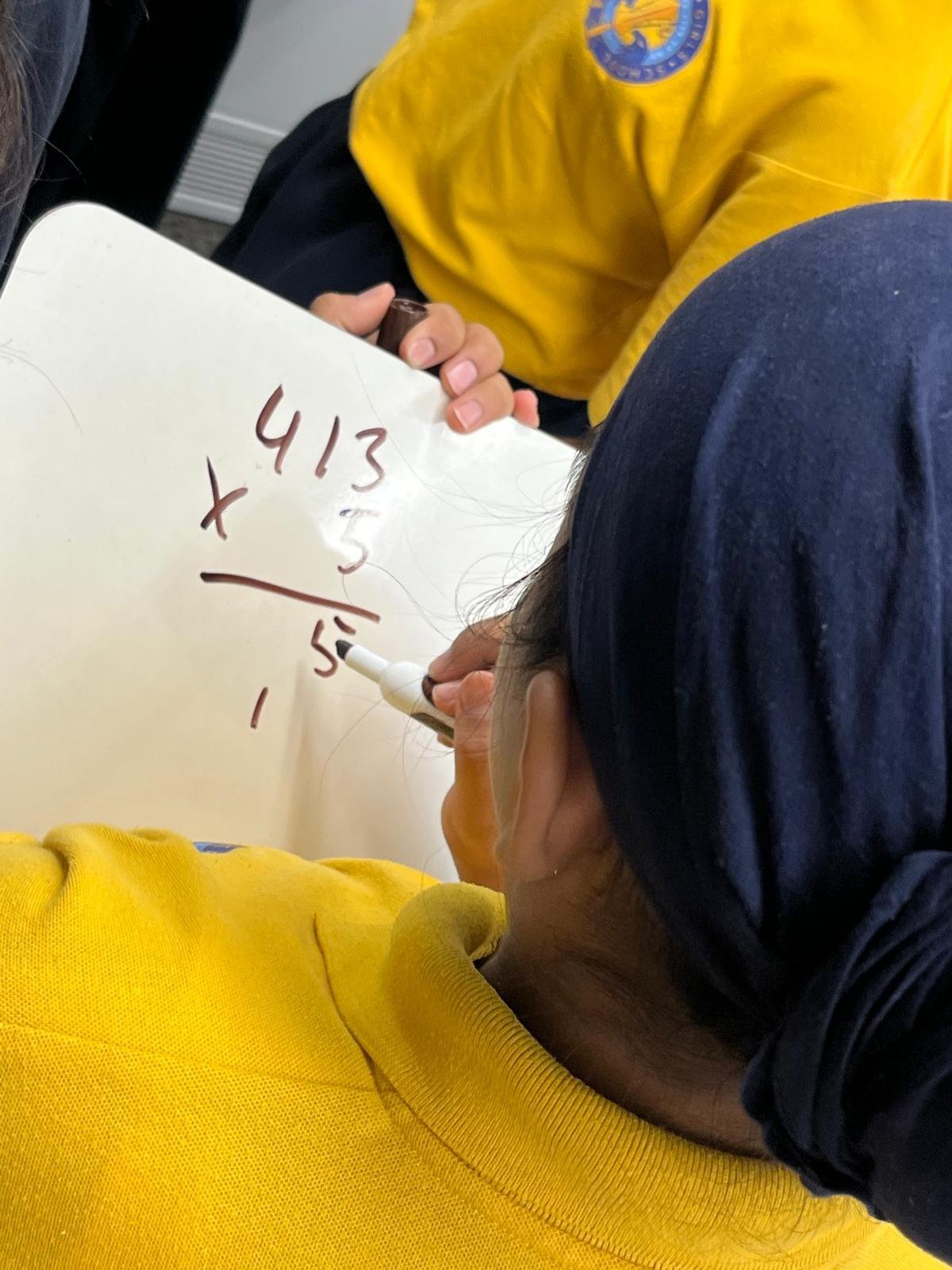
Maths
At Sikh Heritage Girls School, mathematics is deliberately ambitious.
We want our girls to become fluent, confident and thoughtful mathematicians who can calculate accurately, recognise structure, make connections, explain their reasoning and persist when the route to an answer is not immediately obvious.
Our curriculum is designed in-house. It is rooted in the National Curriculum, but it is not limited by it. We build secure foundations carefully, then take pupils further through deeper reasoning, rich problem-solving, mathematical discussion and sustained challenge.
Our ambition is for the majority of pupils to achieve at greater depth, while ensuring that every girl develops strong mathematical knowledge and is taught towards ambitious outcomes.
At SHGS, greater challenge does not simply mean moving on faster.
It means thinking more deeply.
Intent
Our mathematics curriculum is designed so that pupils develop:
* secure number sense and fluent recall;
* accurate and increasingly efficient calculation;
* strong conceptual understanding;
* confidence in choosing and explaining methods;
* precise mathematical vocabulary;
* the ability to reason, justify and prove;
* resilience when faced with unfamiliar problems;
* independence in applying what they know.
Fluency and depth go hand in hand.
Pupils need secure facts, efficient methods and regular practice, but they must also understand the mathematics beneath them. We want girls who know what to do, understand why it works and can decide when a different approach might be better.
Implementation
Mathematical knowledge is carefully sequenced at SHGS.
Complex ideas are broken into manageable steps and teachers pay close attention to prerequisite knowledge, misconceptions and the connections pupils need to make between one idea and the next. Important learning is revisited so that knowledge becomes secure, flexible and increasingly easy to apply.
Our pupils are expected to think as well as calculate.
Mathematical talk is therefore an important part of lessons. Girls explain methods, compare approaches, identify errors, use precise vocabulary and justify conclusions. Teachers regularly ask pupils to consider questions such as:
How do you know?
Can you prove it?
Is that always true?
Can you find another way?
Manipulatives and representations are used purposefully throughout the school, including in Years 5 and 6. They are not regarded simply as resources for younger pupils or for those who need additional support. They are mathematical tools that help pupils expose structure, test ideas and make abstract relationships visible.
All pupils, including those with SEND, access high-quality mathematics every day. Where pupils need additional support, teachers adapt the route into the learning through careful modelling, additional practice, manipulatives, visual representations, smaller steps or adapted recording. The mathematical ambition remains high.
Rich Mathematical Challenge
Challenge is an important part of mathematics at SHGS.
We make deliberate use of NRICH problems to give pupils experience of mathematics where the method is not provided and the solution may not be immediately obvious.
Girls learn to explore, organise information, notice patterns, make conjectures, test ideas, reconsider unsuccessful approaches and explain what they have discovered.
These experiences matter because strong mathematicians do more than complete familiar calculations. They need to be able to use what they know when the problem looks different.
National mathematical competitions extend this culture of challenge.
All girls have opportunities to experience national mathematical challenge through the First Mathematics Challenge, with further opportunities through the Primary Maths Challenge and Primary Kangaroo, according to age, readiness and performance.
These competitions give pupils experience of unfamiliar and demanding questions and encourage them to draw together knowledge from across mathematics.

Assessment
Assessment helps us understand what pupils know, what is secure and what needs further attention.
Teachers assess continuously through questioning, discussion, pupils’ written work and diagnostic tasks. Formal summative assessment takes place at key points during the year and is used to identify strengths, misconceptions and gaps in understanding.
Our curriculum is deliberately designed so that pupils become increasingly able to retrieve knowledge, reason independently and apply mathematics to unfamiliar questions.
We do not teach pupils to pass a particular test.
We teach mathematics deeply enough that pupils are ready to demonstrate what they know independently.
Impact
By the time pupils leave SHGS, we want them to:
* calculate fluently and accurately;
* remember and use important mathematical knowledge;
* recognise mathematical structures and relationships;
* choose efficient methods independently;
* explain and defend their reasoning;
* use representations intelligently;
* solve unfamiliar problems with increasing confidence;
* persevere when mathematics becomes difficult;
* achieve highly and be ready for the next stage of their education.
Most importantly, we want our girls to see mathematics as a subject in which they can excel.
Mathematics opens doors to fields including engineering, architecture, medicine, technology, economics, finance, data science and research. We want pupils to leave SHGS with both the mathematical knowledge and the confidence to recognise that those opportunities are open to them.
Research-Informed Practice
Our approach is informed by research into effective mathematics teaching, curriculum sequencing, mathematical reasoning, problem-solving and the purposeful use of representations.
We draw particularly on guidance from the Education Endowment Foundation, Ofsted’s mathematics research, NRICH and the work of Jo Boaler on mathematical thinking and learner confidence.
Selected References
Education Endowment Foundation. Improving Mathematics in Key Stages 2 and 3.
Ofsted. Research Review Series: Mathematics.
Ofsted. Coordinating Mathematical Success: The Mathematics Subject Report.
NRICH. Research and professional guidance on mathematical thinking and rich problem-solving.
Boaler, J. (2016). Mathematical Mindsets: Unleashing Students' Potential through Creative Math, Inspiring Messages, and Innovative Teaching. Jossey-Bass.